Well, it's been a busy summer. Last year I was excited to introduce PyMentorAI, an…
Which Juzz’ has the most verses?
One of the first things that anyone learns about the holy Qur’ān is that there are 114 chapters of varying length, with the longest being Sūrah al-Baqarah with 286 verses, and the shortest chapters having just 3 verses. So it’s no surprise to anyone that different chapters can have vastly different numbers of verses.
It is also well-known that the Qur’ān is also divided into 30 parts, and these are generally around the same length, measured in terms of pages. Pages are a more reliable indicator of actual length, or “reading time”, than verses, since verses also vary enormously in length.
But one connection I haven’t seen mentioned enough is the variance in the number of verses per part of the Qur’ān. How does the length of each juzz’ compare with the others in terms of the number of verses it contains? Sure, they all span the same number of pages, but certainly a juzz’ consisting of short verses will have more verses in it will have more verses overall than a juzz’ consisting of longer ones. So which juzz’ has the most verses? We can investigate this.
Clarifying Assumptions
Right off the bat, let’s clarify: the starting and ending points of each juzz’ is not something that is consistent across all copies of the Qur’ān. For example, some copies of the Qur’ān (like the ones popular in the Indo-Pak subcontinent) put the start of Juzz’ 14 at Sūrah al-Ḥijr, verse 2, whereas the global standard ‘Uthmān Ṭāhā script copies put it at verse 1.
There are probably reasons for why these divisions were decided this way, and although there are no consequences for these differences in terms of the meaning of the Qur’ān, there are some practical ramifications of having multiple ways of defining the 30 parts1. In any case, to be consistent, I’m using the parts as defined in the ‘Uthmān Ṭāhā muṣḥaf for this work.
(Oh, and it’s also worth mentioning that aside from Sūrah al-Fātiḥah, I’m not counting the Basmalah as a separate verse for any of the chapters, as standard practice.)
Part Lengths by Verses: The Data
So, with knowledge of where each juzz’ begins and how many verses are in each chapter, we can easily calculate how many verses fall within each juzz’. The results are tabulated below:
| Juzz’ | Juzz’ Starting Point: Chapter | Juzz’ Starting point: Verse | Number of Verses in the Juzz’ |
|---|---|---|---|
| 1 | 1 | 1 | 148 |
| 2 | 2 | 142 | 111 |
| 3 | 2 | 253 | 126 |
| 4 | 3 | 93 | 131 |
| 5 | 4 | 24 | 124 |
| 6 | 4 | 148 | 110 |
| 7 | 5 | 82 | 149 |
| 8 | 6 | 111 | 142 |
| 9 | 7 | 88 | 159 |
| 10 | 8 | 41 | 127 |
| 11 | 9 | 93 | 151 |
| 12 | 11 | 6 | 170 |
| 13 | 12 | 53 | 154 |
| 14 | 15 | 1 | 227 |
| 15 | 17 | 1 | 185 |
| 16 | 18 | 75 | 269 |
| 17 | 21 | 1 | 190 |
| 18 | 23 | 1 | 202 |
| 19 | 25 | 21 | 339 |
| 20 | 27 | 56 | 171 |
| 21 | 29 | 46 | 178 |
| 22 | 33 | 31 | 169 |
| 23 | 36 | 28 | 357 |
| 24 | 39 | 32 | 175 |
| 25 | 41 | 47 | 246 |
| 26 | 46 | 1 | 195 |
| 27 | 51 | 31 | 399 |
| 28 | 58 | 1 | 137 |
| 29 | 67 | 1 | 431 |
| 30 | 78 | 1 | 564 |
Part Lengths by Verses: In Graphs
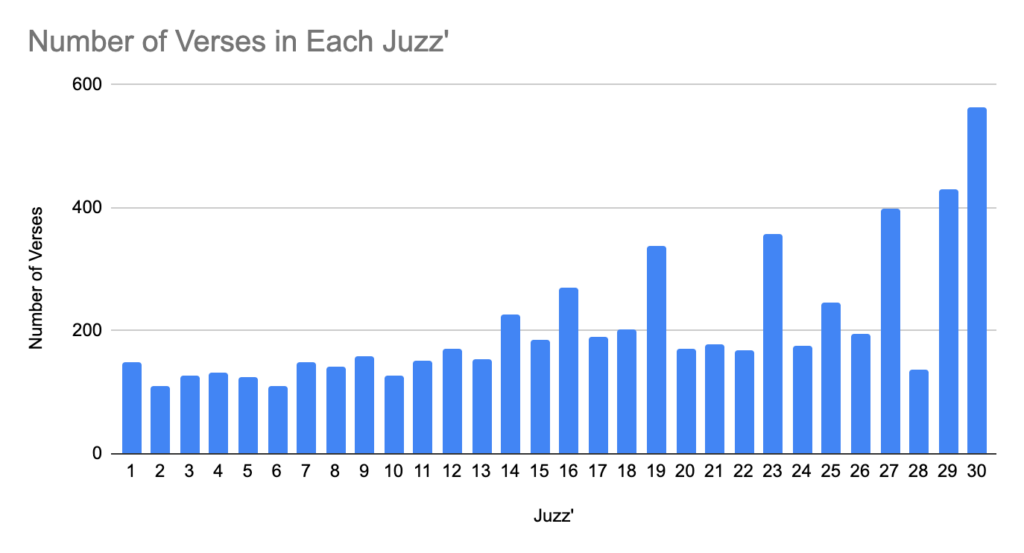
Let’s put the table above into a graph:
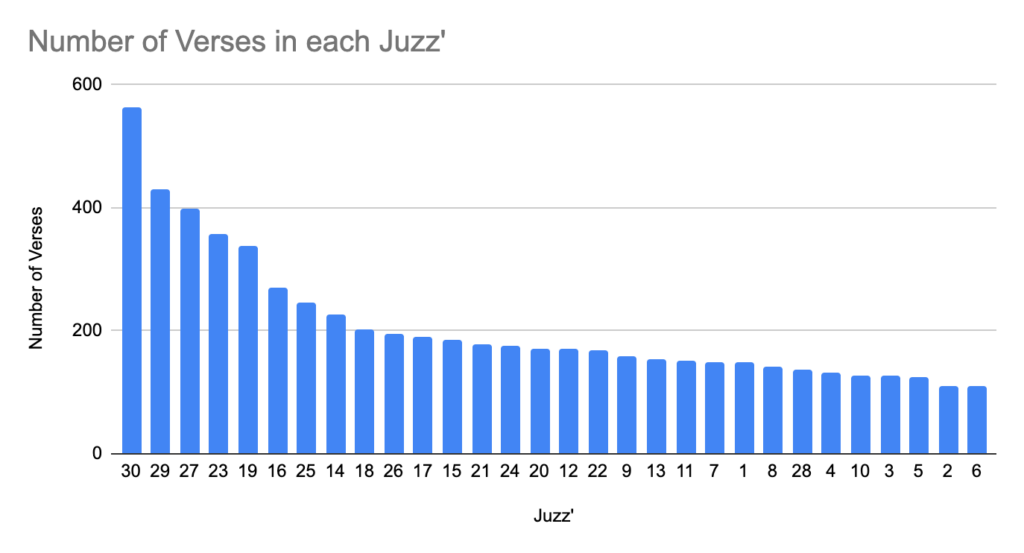
And in case you prefer seeing them arranged in a sorted order:
Takeaways
So, what can we uncover from all of this? Here are some observations:
- Most of the 30 parts of the Qur’ān have roughly the same number of verses, between around 130-200.
- The thirtieth (and final) part has the most verses by far, with more than 130 verses ahead of the second place winner. No surprise, since the last juzz’ is famous for having short chapters with short verses.
- The second and the sixth parts, thanks to the length verses of the chapters of al-Baqarah, al-Nisā’, and al-Mā’idah, have the fewest verses.
- It’s not the case that all the parts at the end of the Qur’ān have the most verses; the 28th juzz’ is one of the parts with the fewest verses, contrary to the parts immediately surrounding it.
Finally, one last graph that shows the cumulative distribution of verses across the 30 parts:
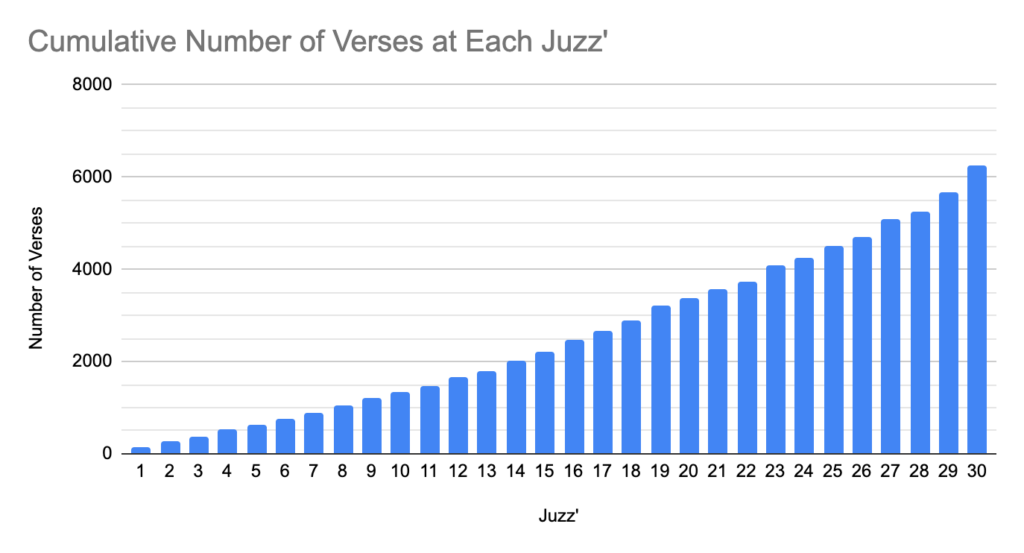
The cumulative graph helps us see where we reach the middle of the Qur’ān, with respect to verses: out of 6236 verses, the middle verse would be verse number 3118, and the graph shows that we hit 3000 verses somewhere in the 19th Juzz’. That checks out with what we saw earlier about the middle verse of the Qur’ān falling in Sūrah al-Shu’arā’, the 26th chapter, which appears in the 19th Juzz’. Nice to have a different way to see this!
- One practical consequence is in works like this one, where analytical results will vary depending on where we demarcate the juzz’ boundaries. Another unintended effect, perhaps more widely applicable and impactful, is when a group of people commit to reciting the entire Qur’ān together by dividing up by parts and allocating some to each person. If the group is not aligned using a single reference for how the parts are divided, it’s possible that some verses will be be read by two different people, and some verses may not be read by anyone at all! ↩︎
This Post Has 0 Comments