One of the first things that anyone learns about the holy Qur'ān is that there…
The Qur’an’s Most Flexible Verbs
One cool thing about the Arabic language is that you can take a base “root word” and extract derivative words with related meanings by plugging the letters of the root word into different templates, or “forms”.
I’m not going to get into the details about how this process works here; we can leave that to the linguists. Instead, I’m interested in exploring a specific question: in the Qur’ān, which root verb appears in the most derivative verb forms? In other words: of all the root verbs that appear in the Qur’ān, which one comes in the biggest variety of flavours?
For reference, there are about a dozen or so common verb forms in the Arabic language, give or take. (In Arabic, a verb form is called a “bāb“.) There are about 986 distinct “root verbs” in the Qur’ān — these are the verbs with 3 or 4 root letters that can be plugged in to the different form templates to make new verbs. Of the 986 root verbs, 637 of them (about 65%) only ever appear in a single verb form in the Qur’ān. The remaining 35% occur in at least two different verb forms. So which root verb appears in the most different forms, and how many forms does it take1?
A simple computer program is all it takes to answer a question like this. I wrote a quick script, ran the code, and retrieved the results. Here’s what we find:
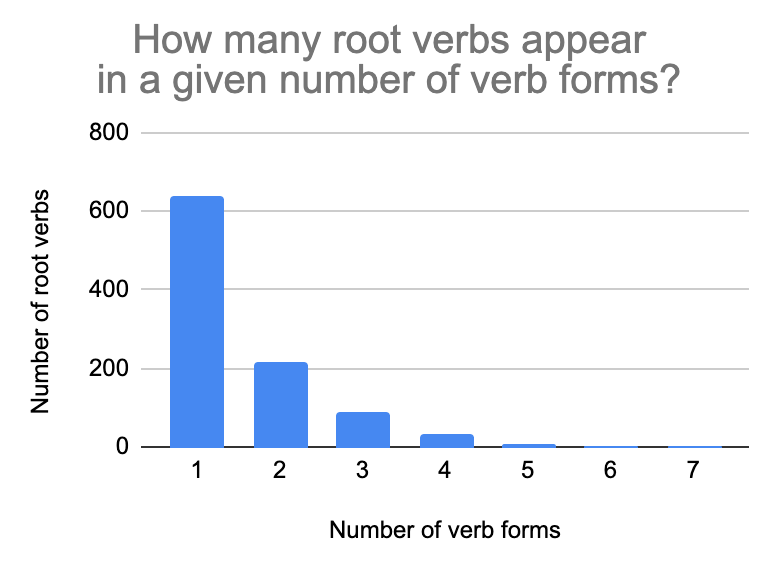
It turns out that it’s not common for root verbs to appear in multiple verb forms, and the higher the number of verb forms, the fewer root verbs fit the pattern. There are only two root verbs that appear across more than five verb forms.
The root verb that appears in the most distinct verb forms is the one with root letters خ ل ف , or “khalafa“, taking on a total of seven (!) different verb forms. The root verb itself has a number of different meanings on its own, including “to follow”, “to be a successor”, “to replace”, and “to stay behind”, among others; the derivative forms all add a distinct semantic flavour to the base meaning, as we will see below.
Here are the seven different forms that the root خ ل ف takes in the Qur’ān, along with a sample occurrence for each. Note: the table lists the derived verbs in order of their frequency for this specific root verb. Also, there might be many meanings for each derived verb; I only included the one that seems most relevant to the sample verse excerpt included in the right column.
| Derived Verb | Meaning of Verb | Sample Verse |
|---|---|---|
| ٱخْتَلَفَ | To be different; to disagree | 2:113 فِيمَا كَانُوا۟ فِيهِ يَخْتَلِفُون “… concerning that about which they used to differ.” |
| أَخْلَفَ | To go back on one’s word | 3:9 إِنَّ ٱللَّهَ لَا يُخْلِفُ ٱلْمِيعَاد “Indeed Allah does not break His promise.” |
| ٱسْتَخْلَفَ | To appoint as successor | 6:133 وَيَسْتَخْلِفْ مِنۢ بَعْدِكُم مَّا يَشَآء “… and [He will] make whomever He wishes succeed you …” |
| خَلَفَ | To be successor, to replace, to be kept back, … | 7:169 فَخَلَفَ مِنۢ بَعْدِهِمْ خَلْفٌ “Then they were succeeded by an [evil] posterity …” |
| خَالَفَ | To be opposed to, to conflict | 11:88 وَمَآ أُرِيدُ أَنْ أُخَالِفَكُمْ إِلَىٰ مَآ أَنْهَىٰكُمْ عَنْه “I do not wish to oppose you by what I forbid you.” |
| خَلَّفَ | To leave behind | 9:118 وَعَلَى ٱلثَّلَـٰثَةِ ٱلَّذِينَ خُلِّفُوا۟ “And to the three who were left behind …” |
| تَخَلَّفَ | To stay behind | 9:120 وَمَنْ حَوْلَهُم مِّنَ ٱلْأَعْرَابِ أَن يَتَخَلَّفُوا۟ عَن رَّسُولِ ٱللَّهِ “… and the Bedouins around them to hang back behind the Apostle of Allah …” |
In close second place was the root verb ل ق ي which spanned across six different verb forms, mostly related to the act of meeting or joining.
And the seven root verbs that each appear in five different verb forms have the root letters:
- ك ب ر
- ن ج و
- ط و ع
- ع ج ل
- أ ذ ن
- غ ش و
- ق س م
Well, that was kind of interesting! I’m sure I would not have guessed some of these as being the most form-flexible verbs, but there you have it.
If I were inclined to speculate, I might comment how fitting it seems that the root verb that shape-shifts the most in the Qur’ān is the one that relates to being different, opposing, or conflicting. But I’m in no position to make a claim about whether this was the intended takeaway. All I can do is read the data and make an observation.
If you liked this, you may be interested to consider a related, reverse question: which verb forms appear most frequently in the Qur’ān? Because we already took a look at that. And wow, that was posted exactly one year ago today? Crazy how that happens…
- For this piece, I only considered verb forms that appear for actual verbs. This means I ignored verb forms that a root verb took on when it appears only a noun derived from a verb. For example: the verb with root letters ق س م appears in the Qur’ān in the verb form of تفعيل when conjugated as a subject noun, or ism fā‘il, in the verse 51:4 as فَٱلْمُقَسِّمَـٰتِ. However, this verb form is never used for this verb root as a verb directly in the Qur’ān. For that reason, we don’t count the تفعيل form as one of the verb forms for the root ق س م here.
↩︎
This Post Has 0 Comments